The place
Life in Whakarewarewa village
Who lives at Whakarewarewa, how the village came to stand among geysers and hot pools, and how its people use the ground beneath their homes.
Book the performance ↗Quick answer
Whakarewarewa is the home of Tūhourangi Ngāti Wāhiao people, and its own site says it is owned and operated by local residents. Te Ara records that Tūhourangi and Ngāti Wāhiao people displaced from the Tarawera area after the 1886 eruption settled there. Residents have long cooked with the geothermal heat in the ground, which is why the village is called a living one.
A home first
The village's own pages describe Whakarewarewa as the legacy and home of the Tūhourangi Ngāti Wāhiao people, and say that it is owned and operated by local residents. When you watch a performance there, you are a guest in a place where people live. The village describes the principle of manaakitanga, hospitality, as an expectation that a host provides kai and rest for visitors, and a visit is best understood in that light.
The name
Wikipedia gives the full name as Te Whakarewarewatanga O Te Ope Taua A Wahiao, meaning the gathering place for the war parties of Wahiao, and says locals often shorten it to Whaka. The village says its people trace their ancestry to the Te Arawa people who first occupied the valley in 1325, so the name belongs to a place with a long history of gathering.
After 1886
Te Ara records that Tūhourangi and Ngāti Wāhiao people displaced from the Tarawera area after the 1886 eruption settled at Whakarewarewa. In its account of Te Arawa, it says kin provided shelter, clothing, lands and food for the survivors, and that most found refuge at Whakarewarewa among others. It adds that the government acquired the devastated area soon after, so Tūhourangi could not return to their Tarawera homeland. The village became a popular visitor destination in the years that followed.
Cooking with the ground
Te Ara describes the hāngī as a traditional Māori earth oven, and says that in regions such as Rotorua hāngī have for centuries been cooked using geothermal steam. A 1901 photograph it holds shows Whakarewarewa residents boiling food in baskets lowered into a hot pool and steaming a hāngī with geothermal heat, and Te Ara says both methods are still used. Before European arrival, it adds, boiling springs were used for cooking and warm pools for bathing, laundry and relaxation.
The gateway and the bridge
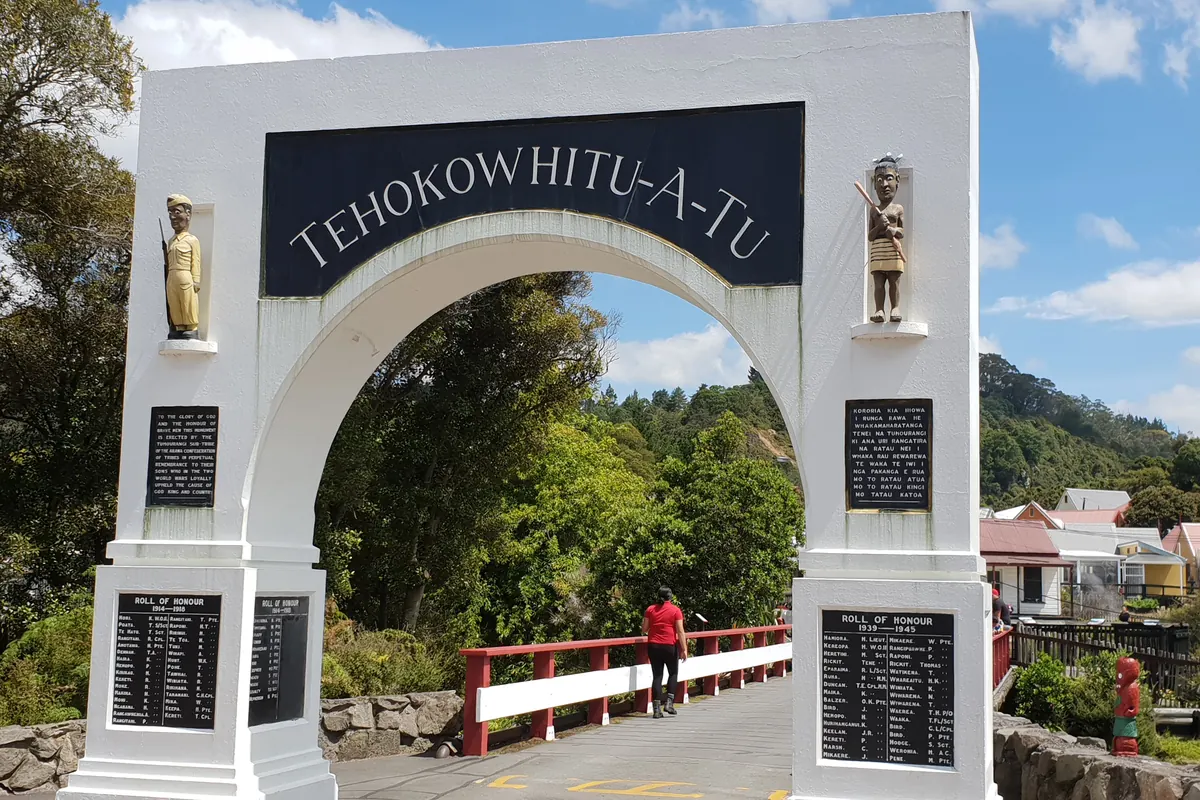
Te Ara says the settlement is reached by a bridge across the Puarenga Stream, where Māori youth have long dived for coins thrown by visitors. The memorial gateway at the entrance commemorates Te Hokowhitu-a-Tū, Māori who served in the two world wars. Both are part of how the village presents itself to the street, and the gateway is a place to pause rather than hurry through on the way to the performance.
Guides who shaped tourism
Te Ara names Mākereti Papakura, known as Guide Maggie, her half-sister Bella Papakura and Rangitīaria Dennan, known as Guide Rangi, among the guides of Whakarewarewa. The village says generations of its guides have been pioneers of tourism in New Zealand. Te Ara also records that in the early 20th century the government controlled how Māori culture was presented at Rotorua. Today the village describes itself as owned and operated by local residents.
What the geysers do
Te Ara says Whakarewarewa has more than 500 hot springs and that the seven geysers on Geyser Flat are where activity is almost always visible, with Pōhutu the largest, regularly erupting to 15–20 metres. It calls Whakarewarewa the only major geyser field remaining in New Zealand. Wikipedia reports that bore closures in the late 1980s were followed by a pronounced recovery in the geysers and hot springs. These are the facts that sit under the performance you came to watch.
Frequently asked questions
Who lives in Whakarewarewa?
The village's own site calls it the home of the Tūhourangi Ngāti Wāhiao people, and says it is owned and operated by local residents.
What does Whakarewarewa mean?
Wikipedia gives the long form as the gathering place for the war parties of Wahiao. Locals often shorten it to Whaka.
Do residents still cook with geothermal heat?
Te Ara says the 1901 methods of boiling food in hot pools and steaming a hāngī are both still used in the region.
Is the village open to everyone?
The village's own site says there is no access without a guide, so book a ticket before you go.
Sources